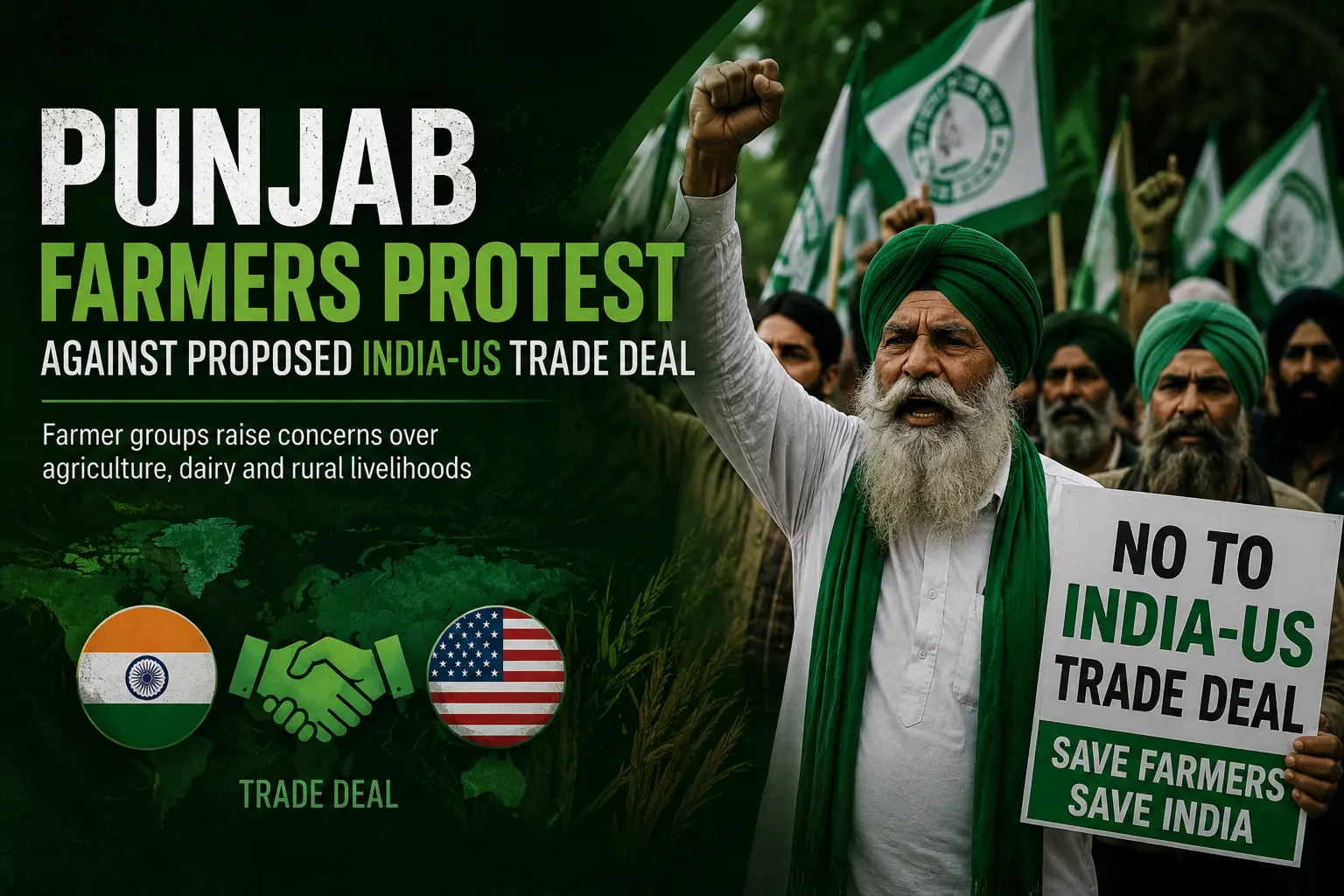
Punjab Farmers Protest Against Proposed India-US Trade Deal
Punjab witnessed widespread demonstrations after farmer organizations voiced strong opposition to the proposed India-US trade agreement. Protesters argue that the agreement could negatively affect India’s agriculture sector, particularly small and marginal farmers who already face financial challenges.
Why Are Farmers Opposing the Trade Deal?
According to leaders of the Kisan Mazdoor Morcha (KMM), the proposed agreement could allow easier entry of American agricultural products into the Indian market. They believe this may create unfair competition because many U.S. farmers benefit from larger farms, advanced technology, and government subsidies.
Farmer representatives argue that Indian farmers—especially those in Punjab—operate on much smaller landholdings and may struggle to compete if cheaper imported products become widely available.
Demonstrations Held Across Punjab
Protests were organized in numerous districts across Punjab, where participants gathered outside government offices and public places to express their concerns.
During the demonstrations, protesters demanded that the government reconsider the proposed agreement and ensure that agriculture and related sectors remain protected during trade negotiations.
Concerns Beyond Farming
Farmer organizations say the issue extends beyond agriculture alone. They believe dairy farmers, agricultural laborers, small businesses, transport workers, and rural youth could also be affected if imported products gain greater access to the Indian market.
According to protest leaders, these sectors are closely connected to Punjab’s rural economy, making the trade agreement an issue affecting multiple livelihoods.
Farmers Call for Greater Consultation
One of the major demands raised during the protests was greater transparency in trade negotiations.
Farmer leaders stated that organizations representing agriculture and dairy sectors should be consulted before any agreement is finalized. They argue that policies affecting millions of farming families should involve discussions with stakeholders directly connected to agriculture.
Government’s Position
The Indian government has maintained that trade negotiations are intended to strengthen economic relations while protecting sensitive sectors. Officials have previously stated that farmers’ interests remain an important consideration during discussions.
However, farmer organizations continue to seek detailed clarification regarding which agricultural products could be included in the final agreement.
What Happens Next?
Farmer groups have indicated that they will continue peaceful demonstrations if their concerns are not addressed. Some organizations have also announced plans for larger protests in the coming weeks should agriculture or dairy products become part of the final India-US trade agreement.